

3PL vs 4PL: What Are the Differences and Which Logistics Model Is Right for Your Business?
In today’s competitive global market, efficient logistics and supply chain management are essential for businesses of all sizes. As companies expand across borders and face increasingly complex transportation requirements, many turn to Third-Party Logistics (3PL) and Fourth-Party Logistics (4PL) providers to improve efficiency, reduce costs, and streamline supply chain operations.
But what exactly are 3PL and 4PL? How are they different, and which model is more suitable for your business?
In this article, we explain the key differences between 3PL and 4PL logistics, their advantages, and how businesses can determine the right logistics solution for their supply chain.
What Is 3PL?
3PL stands for Third-Party Logistics. A 3PL provider is an external logistics company that manages specific logistics activities on behalf of a business.
Depending on the customer’s requirements, a 3PL provider may offer services such as:
- Freight forwarding
- Ocean freight and air freight
- Transportation and trucking
- Warehousing and distribution
- Customs clearance
- Cargo consolidation
- Inventory management
- Import and export logistics
- Last-mile delivery
By outsourcing these activities to a 3PL provider, businesses can focus on their core operations while relying on logistics specialists to manage transportation and related processes.

Benefits of 3PL
Working with a 3PL provider can provide several advantages:
1. Reduced logistics costs
3PL providers can leverage their transportation networks, carrier relationships, and operational expertise to help businesses manage logistics costs more effectively.
2. Access to logistics expertise
Businesses can benefit from professional knowledge of freight transportation, customs procedures, documentation, and international trade requirements.
3. Greater operational flexibility
3PL solutions can be scaled according to shipment volumes, market demand, and business expansion.
4. Improved delivery efficiency
Professional logistics providers can coordinate transportation and shipment processes to support reliable and efficient cargo movement.

What Is 4PL?
4PL stands for Fourth-Party Logistics. Unlike a traditional 3PL provider that primarily manages logistics operations, a 4PL provider takes a broader role in coordinating and managing the entire supply chain.
A 4PL provider typically acts as a strategic supply chain integrator. Instead of simply handling transportation or warehousing, the provider may coordinate multiple logistics partners, technologies, transportation providers, and other supply chain resources.
For example, a 4PL provider may oversee several 3PL companies and coordinate their activities to create one integrated supply chain strategy.

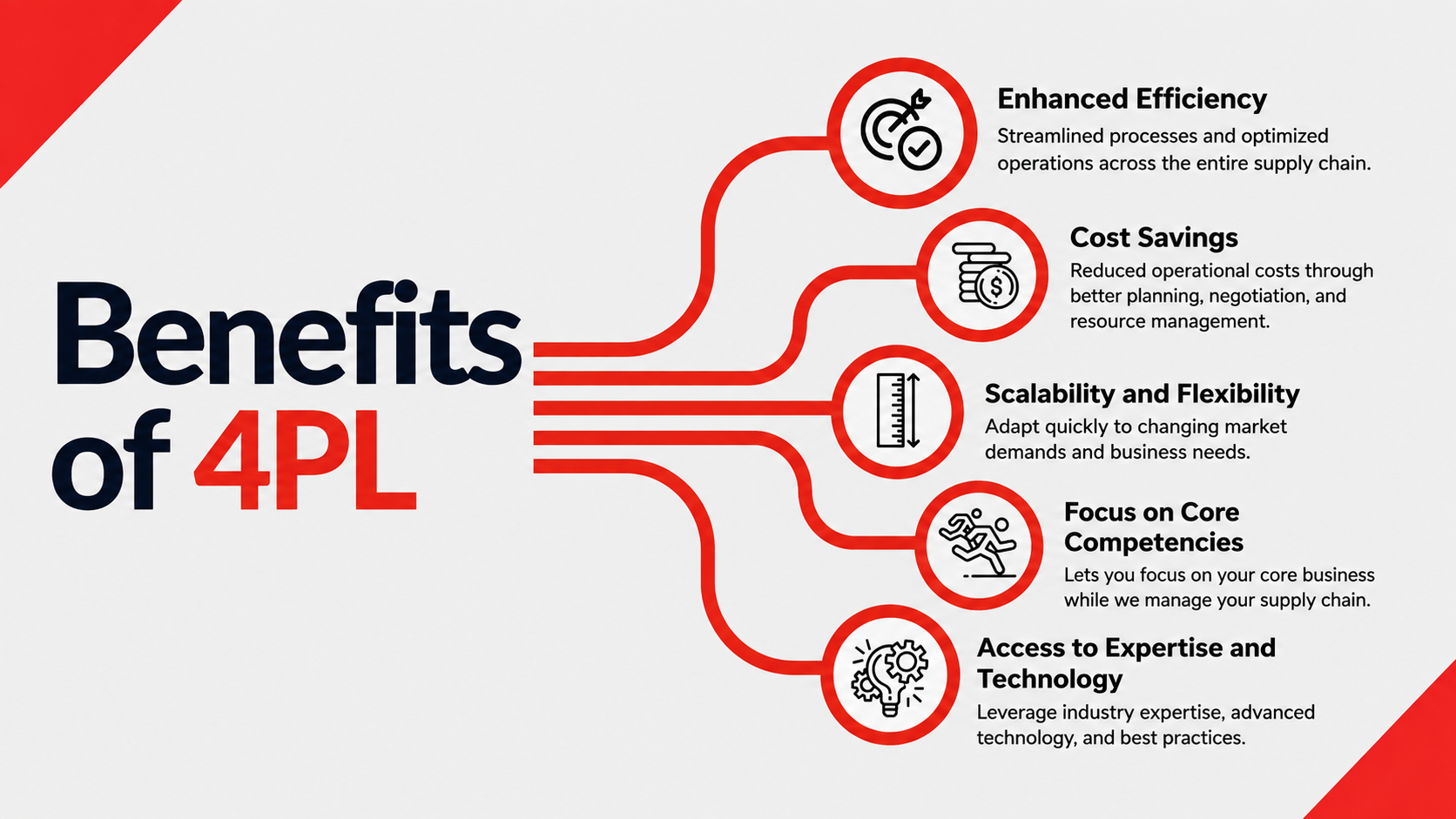
Benefits of 4PL
1. End-to-end supply chain management
4PL providers can coordinate multiple logistics functions and partners across the supply chain.
2. Strategic supply chain optimization
A 4PL model focuses not only on moving goods but also on improving the overall performance of the supply chain.
3. Centralized management
Businesses can have a single strategic partner coordinating multiple logistics providers and activities.
4. Better visibility and coordination
Technology and centralized data management can help businesses gain greater visibility into logistics operations and make more informed decisions.
3PL vs 4PL: What Is the Difference?
The key difference between 3PL and 4PL is their scope of responsibility.
| Criteria | 3PL | 4PL |
|---|---|---|
| Main role | Logistics service provider | Supply chain integrator |
| Focus | Specific logistics operations | End-to-end supply chain management |
| Transportation | Directly manages/provides services | Coordinates transportation providers |
| Warehousing | May provide and manage warehouses | Oversees warehousing partners |
| Multiple logistics providers | Usually limited | Coordinates multiple providers |
| Technology & data | Supports logistics operations | Often integrates supply chain systems |
| Strategic role | Operational | Strategic and managerial |
| Best suited for | Companies outsourcing logistics activities | Companies seeking comprehensive supply chain optimization |
In simple terms:
3PL = “We manage your logistics activities.”
4PL = “We coordinate and optimize your entire supply chain.”
When Should You Choose a 3PL Provider?
A 3PL solution may be suitable when your business needs help with specific logistics activities without outsourcing overall supply chain management.
For example, a company may work with a 3PL provider when it needs:
- International freight forwarding
- Ocean or air freight services
- Customs clearance
- Transportation
- Warehousing
- Distribution
- Cargo consolidation
For businesses that already have an internal supply chain management team, 3PL can be an efficient way to outsource operational logistics functions.
When Should You Consider 4PL?
A 4PL model may be more appropriate for companies with complex or global supply chains involving multiple logistics providers, markets, and transportation modes.
Businesses may consider 4PL when they need:
- End-to-end supply chain management
- Coordination of multiple logistics providers
- Supply chain visibility
- Strategic logistics planning
- Technology integration
- Performance monitoring
- Supply chain optimization
Rather than managing individual logistics activities separately, businesses can work with a 4PL partner to coordinate the entire logistics ecosystem.
3PL and 4PL in Global Logistics
Global trade involves multiple stages, including suppliers, manufacturers, freight forwarders, carriers, ports, customs authorities, warehouses, and final customers.
A 3PL provider typically manages one or more operational logistics functions within this network.
A 4PL provider, on the other hand, focuses on coordinating different logistics functions and service providers to create a more integrated supply chain.
The right model depends on the complexity of the business, logistics requirements, internal resources, and long-term supply chain strategy.
How PASL Supports Your Logistics Operations
At Pacific Star Logistics (PASL), we understand that every shipment requires careful coordination, reliable communication, and efficient logistics execution.
Our logistics solutions are designed to support businesses with their international freight and supply chain requirements, helping customers move cargo efficiently across global markets.
Whether your business requires freight forwarding, transportation coordination, customs support, or other logistics services, choosing the right logistics partner can make a significant difference to your supply chain performance.
Conclusion
Understanding the difference between 3PL and 4PL is important when deciding how to manage your logistics and supply chain operations.
A 3PL provider primarily handles specific logistics activities such as freight forwarding, transportation, warehousing, and distribution. A 4PL provider takes a broader strategic role by coordinating multiple logistics partners and managing the supply chain as an integrated system.
For businesses looking to outsource specific logistics operations, 3PL can be a practical and flexible solution. For organizations managing complex, multi-provider supply chains, 4PL may provide greater strategic coordination and visibility.
The most suitable model ultimately depends on your business objectives, supply chain complexity, and logistics requirements.
Looking for reliable logistics solutions for your international shipments? Contact Pacific Star Logistics (PASL) to discuss your logistics requirements and find the right solution for your business.