


Vietnam’s export turnover of computers, electronic products and components, along with phones and components, reached US$207.02 billion in the first 10 months of 2026, posting strong growth year over year. These two product categories accounted for 41.5% of the country’s total export turnover, further cementing their important role in Vietnam’s international trade and manufacturing supply chain.
Electronics and Phone Exports Contribute Over 41% of Total Export Turnover
According to preliminary data released by the General Department of Customs under the Ministry of Finance on November 4, 2026, Vietnam’s total merchandise export turnover in October reached US$64.67 billion, up 8.7% from the previous month. Cumulatively for the first 10 months of the year, export turnover reached US$499.23 billion, up 27.5% from the same period in 2025.
On the import side, import turnover in October reached US$57.36 billion, down 1.4% from September. However, for the 10-month aggregate, total import value still reached US$511.31 billion, up 37.4% year over year.
Notably, the two categories — computers, electronic products and components; and phones and components — continued to hold a key position in Vietnam’s trade structure. Combined export turnover of the two categories reached US$207.02 billion, representing 41.5% of the country’s total export value. Meanwhile, import turnover of the two categories accounted for 43.9% of total import turnover.
These results show that the electronics industry is playing a major role in Vietnam’s import-export activity. However, the high import share also reflects substantial demand for components, raw materials, and input products serving the production and assembly of goods for export.
Computer and Electronics Exports Post 71% Growth
Among the two key export categories, computers, electronic products and components recorded the most outstanding growth.
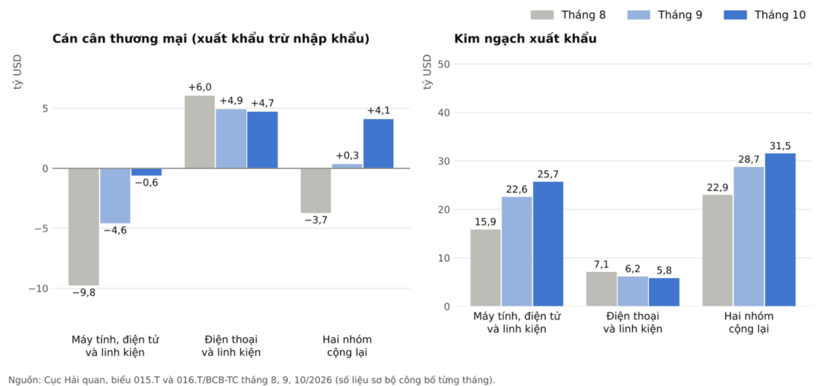
In October 2026 alone, export turnover of this category reached US$25.68 billion, up 13.8% from the previous month and roughly 2.6 times higher than the same period in 2025. Cumulatively for 10 months, export value reached US$149.41 billion, up 71% year over year, equivalent to 29.9% of the country’s total export turnover.
This growth momentum indicates that demand for electronic products and components remains at a high level. Vietnam is shouldering an important role in manufacturing, assembling, and supplying technology products for international markets.
However, domestic production still depends considerably on imported components. In October, import turnover of computers, electronic products and components reached US$26.28 billion, down 3.2% from the previous month. For the 10-month period, import value reached US$215.25 billion, up 74.4% year over year and accounting for 42.1% of Vietnam’s total import turnover.
The high import level primarily reflects demand for inputs serving the production and assembly of goods destined for export. This shows that electronics export growth depends not only on consumption demand in international markets but is also closely tied to the ability to maintain a steady supply of components, equipment, and raw materials from abroad.
For import-export operations, this dependence raises requirements around securing input supply, controlling transit times, and maintaining supply chain continuity. Fluctuations in component prices or lead times can affect production schedules and businesses’ delivery plans.
Phone and Component Exports Sustain Growth Momentum
Alongside the computer and electronics category, phones and components continue to be one of Vietnam’s highest-value export categories.
In October 2026, export turnover of phones and components reached US$5.84 billion, up roughly 15% year over year. However, compared with September, export value fell 5.4%.
Cumulatively for the first 10 months, export turnover of this category reached US$57.61 billion, up 18.4% from the same period in 2025 and accounting for 11.5% of the country’s total export turnover.
On the import side, the value of phones and components in October reached US$1.14 billion, down 9.2% from the previous month. For the 10-month aggregate, import turnover reached US$9.26 billion, down 1.6% year over year.
Unlike the computer and electronics category, which is recording very large imports, phones and components continue to maintain a significant trade surplus. This is one of the factors helping balance the electronics sector’s overall trade account.
Although phone export turnover continues to grow, the month-on-month decline shows that performance across product categories is not entirely uniform. Tracking each category separately therefore provides a more accurate assessment of export trends and production demand in the final months of the year.
Industrial Production Expands, Laying the Groundwork for Export Growth
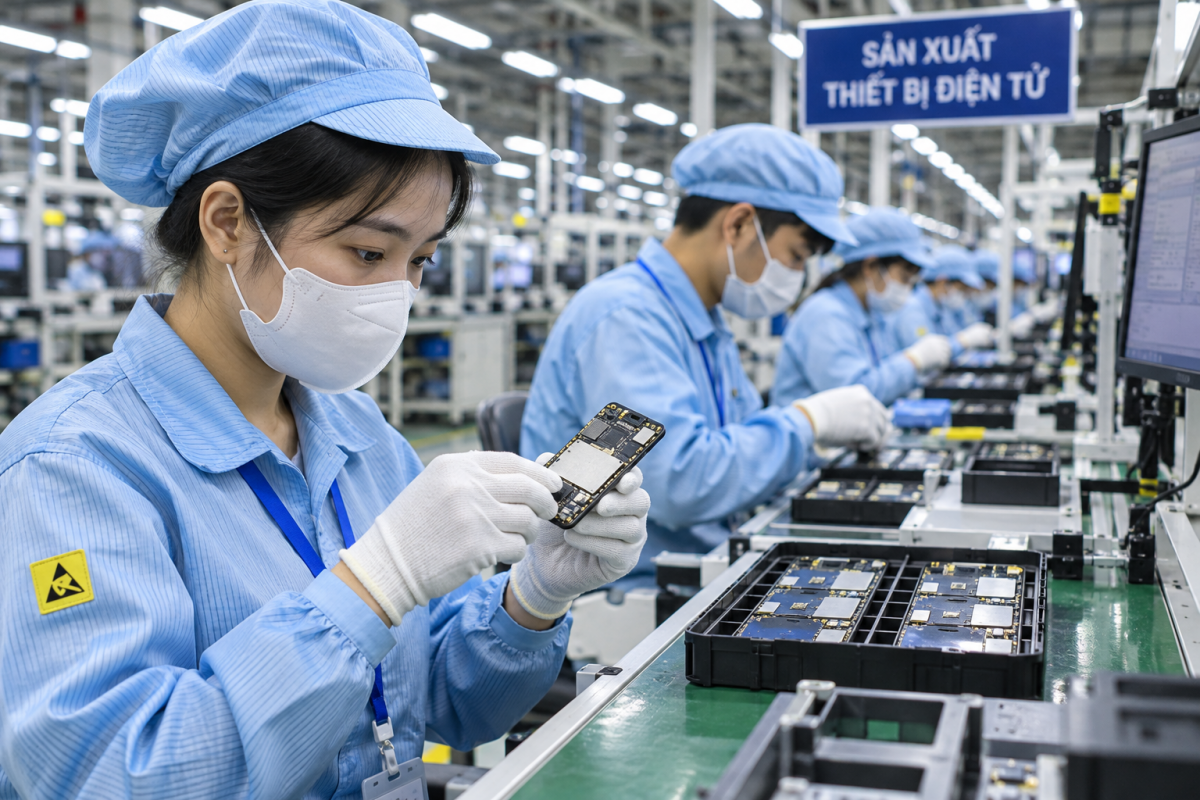
The electronics export upswing has been supported by the expansion of domestic production.
According to the Statistics Office under the Ministry of Finance, the Industrial Production Index (IIP) for the economy as a whole rose 12.4% in the first 10 months of 2026. The manufacture of electronic products, computers, and optical products alone grew 15.2%.
Several technology products posted notable output gains. Laptop output was estimated at 53.5 million units, up 25.86% year over year, while tablet output reached 14.7 million units, up 36.61%.
The increase in output of these items helps expand the supply capacity of domestic manufacturers and provides the basis for meeting order demand in the year-end period.
However, expanded production also brings substantial demand for components and sub-assemblies. For the electronics industry, many key materials and components — such as semiconductor chips, memory, displays, integrated circuits, and printed circuit boards — are still sourced mainly from abroad.
According to detailed data through the end of September 2026, export turnover of computer and electronic components reached US$69.03 billion, up 99.82% year over year and accounting for 55.8% of the total export turnover of the corresponding category.
Notably, memory products alone recorded an export value of US$36.67 billion, up 128.71%, while phone component exports reached US$18.71 billion, up 10.80%.
These figures show that components are contributing an increasingly large share of the electronics industry’s export value. Beyond exporting finished products, Vietnam is also recording significant growth in components and parts serving the production of technology devices.
Electronics Category’s Trade Surplus Improves in October
A notable point in electronics import-export activity is the improvement in the trade balance over the past three months.
In August 2026, the combined total for the two categories — computers, electronic products and components; and phones and components — recorded a trade deficit of US$3.72 billion. By September, the trade balance swung to a surplus of US$340 million. By October, the surplus widened to US$4.10 billion.
This development mainly resulted from the combination of the phone category’s surplus and the narrowing deficit in the computer, electronic products and components category.
Specifically, the phone and components category continued to maintain a trade surplus, posting US$6.04 billion in August, US$4.92 billion in September, and US$4.70 billion in October.
Meanwhile, the computer, electronic products and components category saw its deficit shrink sharply month after month — from US$9.76 billion in August to US$4.58 billion in September, and down to just US$600 million in October.
This was the lowest deficit for the category since April 2018. As a result, the trade balance of the two categories improved considerably, helping lift Vietnam’s overall trade surplus in October to US$7.31 billion.
However, over the full 10-month period, the two categories still recorded a trade deficit of roughly US$17.5 billion. Total export turnover reached US$207.02 billion, while imports totaled US$224.51 billion.
This shows that despite strong electronics export growth, demand for imported inputs remains high. The October improvement in the trade balance is a positive signal, but it is not yet sufficient to conclude that the categories’ overall trade deficit has been resolved.
Memory Demand and International Prices Support Export Outlook
In the final two months of 2026, electronics and component exports are expected to sustain their growth trend, driven by two main factors: international demand for memory products and domestic manufacturing capacity.
First, the global semiconductor market is posting remarkable growth. According to a report by the Center for Industry and Trade Information, based on data from the Semiconductor Industry Association (SIA), global semiconductor sales in August 2026 reached US$159.7 billion, up 144.3% year over year.
In addition, TrendForce forecasts that DRAM prices could rise 10% to 15% in Q4 2026.
This development could provide further momentum for Vietnam’s component export value, particularly given that memory product exports had already reached US$36.67 billion through the end of September, up 128.71% year over year.
If international prices continue to climb, export revenue for the component segment could receive additional support. However, the actual impact will depend on product mix, export volumes, and businesses’ capacity to fulfill orders.
The second factor comes from domestic manufacturing capacity. Laptop output growth of 25.86% and tablet output growth of 36.61% in the first 10 months indicate that the supply of products for year-end orders is being scaled up.
That said, the 3.2% month-on-month decline in October’s import turnover of computers and electronic products is also a development worth monitoring. Since components are typically imported ahead of production and finished-product exports, changes in import value can offer additional insight into input demand and manufacturing activity in the coming months.
Component import trends in November and December are therefore among the indicators to watch when assessing the electronics export outlook for the year-end period.
Strengthening Linkages Between FDI and Domestic Enterprises
Beyond expanding export turnover, enhancing the supply chain participation capacity of domestic enterprises is also a key issue for Vietnam’s electronics industry.
According to the Center for Industry and Trade Information, critical components such as microprocessors, semiconductor chips, memory products, displays, and circuit boards are still supplied mainly from abroad.
Meanwhile, domestic enterprises have begun supplying certain components, accessories, and production-support services. This is seen as a foundation for expanding linkages between FDI enterprises and local suppliers, gradually raising the capacity of the supporting industries.
This direction aligns with the goals of the Supporting Industries Development Program for the 2026–2035 period, issued under Decision No. 929/QD-TTg dated May 25, 2026.
Several recent cooperation programs are helping to operationalize this direction. Since May 2026, the Smart Factory Development Cooperation Project for the Southern region, jointly implemented by Samsung Vietnam and the Ho Chi Minh City Department of Industry and Trade, has been supporting Vietnamese enterprises in digitizing their production operations.
Through such cooperation programs, domestic enterprises gain opportunities to improve management processes, raise operational efficiency, and progressively meet the requirements of multinational corporations.
At a forum held in Bac Ninh on November 4, 2026, attendees were informed that the province had attracted approximately 3,700 FDI projects with total registered capital of around US$52.5 billion as of September 2026. Delegates emphasized the importance of developing supporting industries and increasing localization rates.
To participate more deeply in the supply chain, Vietnamese enterprises need to continue investing in technical workforce training, strengthen component design and testing capabilities, and meet the quality standards set by multinational corporations.
Developing domestic supply capacity not only helps enterprises expand their access to orders from FDI manufacturers but also contributes to reducing dependence on foreign-sourced components.
Exporters Should Monitor the EU’s Cybersecurity Regulations
Beyond production and supply chain factors, compliance requirements in destination markets are another matter that electronics enterprises need to watch.
For enterprises exporting data-connected products to the European Union (EU) market, Regulation (EU) 2024/2847 on Cyber Resilience is one of the key instruments to monitor.
The Regulation entered into force on December 10, 2024, with its main obligations applying from December 11, 2027. It sets out cybersecurity requirements spanning the entire product lifecycle.
This means enterprises must focus not only on product quality and functionality at market launch but also on cybersecurity requirements throughout product development, manufacturing, and maintenance.
For Vietnamese enterprises participating in international electronics supply chains, proactively studying and building capacity to meet such regulations will help mitigate compliance risks when accessing markets with high technical requirements.
Outlook for Vietnam’s Electronics Exports in the Final Months of 2026
With export turnover of US$207.02 billion in the first 10 months of the year, the categories of computers, electronic products and components, together with phones and components, remain a key driver of Vietnam’s export activity.
Industrial production growth, international demand for memory products, and the expansion of laptop and tablet output are creating favorable foundations for exports in the year-end period.
However, the industry still faces several issues requiring close attention — notably its dependence on imported components, the cumulative trade deficit, and the need to comply with technical standards in international markets.
In the long run, strengthening linkages between FDI and domestic enterprises, developing supporting industries, and building component manufacturing capacity will be of great significance for deeper participation in global value chains.
These factors affect not only the electronics export outlook but also determine how proactively Vietnamese enterprises can secure input supply, organize production, and maintain their competitiveness in international markets.
Source:
https://ven.congthuong.vn
https://dientuungdung.vn
https://vneconomy.vn
https://www.vietnam.vn
PACIFIC STAR LOGISTICS CO.LTD
📞 +84 938 111 005
📩 info@pasl.com.vn
🏘️27-29 Ngo Thi Bi Street, Tan Hung Ward, Hochiminh City