

Morocco is accelerating its port infrastructure development strategy, with plans to add approximately 9.8 million TEU of annual container handling capacity by 2031. With the participation of three of the world’s leading shipping groups – MSC, CMA CGM, and Maersk – this North African country is steadily consolidating its position as a cargo transshipment hub in the Mediterranean, at a time when container transshipment at Spain’s major ports is showing signs of plateauing.
Morocco Accelerates Container Port Development with Three Major Shipping Groups On Board

On October 31, 2026, Crown Prince Moulay El Hassan officially launched the first container handling operations at the East Terminal of Nador West Med port. The event was attended by Diego Aponte, Chairman of Mediterranean Shipping Company (MSC), along with Ammar Kanaan, CEO of Terminal Investment Limited (TiL) – MSC’s container port investment and operating arm.
According to Morocco’s state news agency Maghreb Arabe Presse (MAP), the state enterprise Marsa Maroc holds 50% plus one share in West Med Container Terminal (WMCT), the entity granted the concession to operate the East Terminal. The remaining equity belongs to TiL.
Three days earlier, the Moroccan government confirmed it had signed a concession contract for the Tanger Med 3 port with APM Terminals (APMT), the port operating arm of the Maersk Group. The project is expected to add 4.5 million containers per year to the Tanger Med port complex’s handling capacity.
In addition, CMA Terminals, the CMA CGM Group’s port operating unit, completed the acquisition of a 49% stake in Nador Container Terminal on October 15, 2026.
As such, all three international shipping groups – MSC, CMA CGM, and Maersk – are now involved in Morocco’s new container port development projects through their respective port operating subsidiaries. This is a significant move that enables the groups to establish a direct presence in port infrastructure operations, while expanding their transport network connectivity and international logistics services.
According to figures compiled from official announcements, the three new projects are expected to add a combined total of approximately 9.8 million TEU of annual container handling capacity by 2031. Of this, Nador East will contribute 3.5 million TEU, Nador West will add 1.8 million TEU, and Tanger Med 3 will provide an estimated 4.5 million TEU.
The fact that all three projects involve port operators belonging to major shipping groups allows Morocco to attract international capital while leveraging existing customer networks and trade lanes to drive operations from the outset.
Tanger Med Under Operational Pressure as Container Throughput Exceeds Design Capacity

Tanger Med is currently one of the most important port and container transshipment hubs in the Mediterranean. However, the pace of cargo volume growth is placing considerable strain on the port’s existing handling capacity.
According to Rachid Houari, Deputy General Manager of Tanger Med, in June 2024 the port’s container terminals were operating at throughput levels above theoretical capacity. At the time, he forecast that the total throughput of the entire complex could exceed its nominal capacity of 9 million TEU in 2024.
Indeed, according to data from the Tanger Med Port Authority (TMPA), container throughput in 2024 reached 10.2 million TEU, roughly 14% above design capacity. In 2025, throughput rose further to 11.1 million TEU after the latest expansion phase at the TC4 terminal, operated by APM Terminals, came on stream.
These figures show that demand for container shipping and transshipment at Tanger Med continues to rise, while existing handling capacity needs further expansion to accommodate cargo flows.
According to Eurokai’s nine-month report published on November 11, 2026, two of Tanger Med’s four container terminals — Eurogate Tanger and Tanger Alliance – handled 2,382,424 TEU between January and September 2026, up 5% from the same period last year. In Q3 2026 alone, throughput at the two terminals grew 7.8%.
However, AIS data from WTCP Intelligence shows that the number of container vessel calls at Tanger Med between July and October 2026 was approximately 8% lower than in the same period of 2025. All four months recorded fewer calls than the corresponding months of the previous year.
Notably, the number of calls by vessels longer than 290 m rose 8.4%, reaching 1,319 in 2025, while total vessel calls declined 4.5% to 16,686.
This development indicates that the fleet profile and operational characteristics at Tanger Med are shifting toward a higher share of large container vessels – a factor that places new demands on quay cranes, cargo-handling equipment, and the capacity to receive large-tonnage vessels.
According to WTCP Intelligence’s Connectivity Index of November 19, 2026, Tanger Med scored 88.3 points, ahead of Valencia at 87.1 and Algeciras at 81.2. The index is measured on a 100-point scale, based on the number of scheduled liner services, shipping lines, and connected partner ports.
Nador West Med: A Strategic Container Port Project with Two New Operating Terminals
Nador West Med is identified as one of the flagship projects in Morocco’s port infrastructure expansion strategy. The port complex comprises two main container terminals – Nador East and Nador West – with the participation of MSC and CMA CGM through their respective port operating subsidiaries.
Nador East: Container Terminal Jointly Operated by MSC and Marsa Maroc

The East container terminal at Nador West Med was granted a 25-year operating concession. According to MAP, the project features 1,520 m of quay wall, an access channel and berth apron depth of 18 m, and a container yard area of approximately 70 ha.
The project is expected to reach an annual handling capacity of 3.5 million containers by 2030, with total private investment of around MAD 5 billion (approximately US$500 million).
The first phase brings 720 m of quay into operation. According to Le360, actual construction progress is running ahead of the original commissioning schedule, initially planned for 2027.
In its announcement of September 10, 2026, West Med Container Terminal stated that five ship-to-shore (STS) cranes had been installed – the first three of the Super Post-Panamax class – along with eight rubber-tyred gantry (RTG) cranes for loading/unloading and container yard management.
Notably, commissioning trials confirmed that the terminal is capable of receiving and handling the largest container vessels currently in service on the ocean shipping market.
On the financing side, WMCT signed a project financing agreement worth €196.7 million (approximately US$224 million) over a 15-year term in July 2026. This funding plays a key role in completing the terminal’s technical infrastructure, equipment, and operational capacity.
According to information released by Marsa Maroc in June 2024, once fully completed, the Nador East terminal is expected to be equipped with 15 quay cranes and 45 RTG cranes. Marsa Maroc’s handling capacity after the terminal comes on stream is estimated at 6.5 million TEU, of which nearly 5 million TEU would be transshipment cargo.
The high proportion of transshipment cargo indicates that Nador East is positioned to become a key link in the international container shipping network, rather than serving domestic import-export demand alone.
Nador West: CMA CGM Expands Its Port Operating Presence
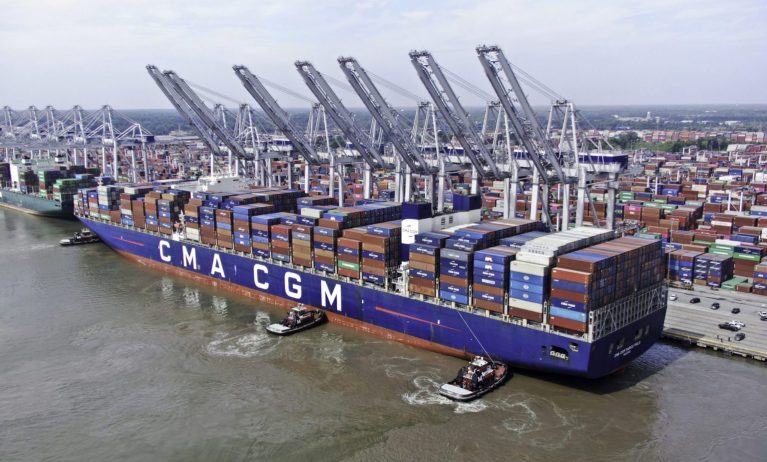
Alongside Nador East, the West container terminal at Nador West Med is also under development with the involvement of CMA Terminals.
On October 15, 2026, CMA Terminals completed the acquisition of a 49% stake in Nador Container Terminal, the concession holder for the Nador West terminal.
Under the plan, the terminal will feature 900 m of quay wall and an annual handling capacity of approximately 1.8 million containers. The project is expected to officially commence operations in April 2027.
Once both the Nador East and Nador West terminals are completed, Nador West Med’s total container handling capacity will reach approximately 5.3 million containers per figures from the Moroccan government’s announcement; concession holders’ figures put the corresponding number at around 5.2 million TEU.
CMA CGM’s participation through CMA Terminals not only expands the group’s port asset portfolio but also strengthens the integration between ocean shipping, port operations, and the logistics supply chain.
According to the Royal Cabinet’s announcement, Nador West Med is positioned to complement the existing Tanger Med port system. The shareholder structures and terminal operators across the two port complexes also reveal a deliberate allocation of roles among the major shipping groups.
At Tanger Med, the four container terminals are currently operated by APM Terminals, Eurogate Tanger, and the Tanger Alliance joint venture, which comprises Marsa Maroc, Eurogate, Contship Italia, and Hapag-Lloyd.
Meanwhile, TiL’s ownership of nearly half of Nador East allows MSC to establish a position in the Nador area, alongside the presence of Maersk and CMA CGM at Morocco’s other new port projects.
Transport Infrastructure Connecting Nador West Med Still Under Completion
Although the container port projects are moving forward at a rapid pace, the transport infrastructure connecting Nador West Med still requires additional time to be completed.
According to Le360, the 49-km railway line connecting the port with Selouane is expected to enter service in 2028. In addition, the 105-km motorway originating from Guercif is expected to be completed by June 2029.
These projects are also referenced in the Moroccan government’s announcement, though the official document does not specify timelines.
In the period before the rail and motorway links are completed, container transportation from Nador East will rely mainly on ocean shipping and road haulage from the Oriental region.
This means that operations in the early years are likely to lean toward transshipment cargo and short-sea shipping — a mode of transport moving goods between ports within the same geographic region, helping strengthen connections between regional shipping lanes and international logistics networks.
Meanwhile, at Tanger Med, road freight traffic serving logistics operations continues to grow. According to TMPA, truck traffic through the port reached 535,203 movements in 2025, up 3.6% from the previous year.
This growth was driven mainly by industrial goods exports, up 4.8%, and agricultural and food products, up 4.3%.
In addition, the Ro-Ro (Roll-on/Roll-off) cargo terminal at Nador West Med was handed over in September 2026. This transport mode allows wheeled vehicles and cargo to drive directly on or off vessels, helping diversify the port’s service portfolio.
The synchronized development of the container terminal, the Ro-Ro terminal, rail, and road links is expected to enhance multimodal connectivity, reduce dependence on any single transport mode, and improve regional cargo flow efficiency.
Container Transshipment at Algeciras and Valencia Shows Signs of Decline

While Morocco ramps up investment in port capacity, Spain’s two major container port hubs – Algeciras and Valencia – have recorded contrasting trends in operations, particularly in the transshipment segment.
According to data from Puertos del Estado published on October 21, 2026, in the first nine months of 2026 the Port of Algeciras handled 3,566,055 TEU, up 0.6% year over year. Of this total, transshipment cargo reached 3,084,840 TEU.
Over the same period, the Port of Valencia handled 4,248,526 TEU, down 0.8%. Notably, transshipment volume at the port reached 1,788,604 TEU, down 9.2% – equivalent to a decline of 181,976 TEU year over year.
Updated figures from the Valencia Port Authority (APV) show that in the first ten months of 2026, the port’s total container throughput reached 4,718,532 TEU, down 0.7%. Within that, full container import (FCL inbound) volume grew 10.8%, while full container exports remained essentially flat.
For Algeciras, the port authority recorded total container throughput of approximately 4 million TEU in the first ten months, up 0.5%. Port Chairman Gerardo Landaluce said in remarks published on November 18 that the port expects to surpass the 100-million-tonne cargo mark for the full year.
However, the operating profiles of the two ports differ considerably. Valencia is growing on the back of direct import-export cargo, whereas Algeciras depends more heavily on container transshipment.
According to calculations based on Puertos del Estado data, transshipment accounts for roughly 87% of total container traffic through Algeciras. Fluctuations in international liner service networks can therefore directly affect the port’s throughput.
Data for the first nine months of 2026 show that combined transshipment volumes at Algeciras and Valencia fell 3.1% year over year. This development raises questions about the shifting distribution of container flows in the Mediterranean, and about whether emerging transshipment hubs are drawing cargo away from traditional ports.
Tanger Med 3: Maersk Continues Expanding Its Port Operating Capacity in Morocco
One of the most notable projects in Morocco’s port expansion strategy is Tanger Med 3, which involves APM Terminals of the Maersk Group.
According to Le360, the new container terminal will be built to the west of Tanger Med 2, with approximately 1,200 m of quay wall and a new 3,000-m breakwater.
Total project investment is estimated at around MAD 8 billion (approximately US$800 million), funded by Tanger Med.
Under the concession contract confirmed in October 2026, Tanger Med 3 is designed for a capacity of 4.5 million containers per year. However, Le360 reports that the project’s potential capacity could reach 5 million TEU.
Construction is expected to begin in late October 2026, with the first container vessel calls possible around mid-2031.
Upon completion, the project will help lift the total container handling capacity of the entire Tanger Med complex to a potential 20 million containers.
APM Terminals currently operates two container terminals, TC1 and TC4, at Tanger Med. When Tanger Med 3 comes on stream, the company will take on its third terminal within the complex.
This allows Maersk to deepen its direct presence in port operations while strengthening integration across ocean shipping, port services, and supply chain management.
Morocco Strengthens Its Competitive Edge in the Mediterranean Container Transshipment Network
The simultaneous rollout of three new container port projects shows that Morocco is pursuing a long-term strategy to expand handling capacity and elevate its standing in the international shipping industry.
With Tanger Med consistently posting throughput above its nominal capacity, the development of Nador West Med and Tanger Med 3 is seen as a solution to redistribute cargo flows, increase capacity to receive container vessels, and expand maritime network connectivity.
Notably, the additional 9.8 million TEU per year represents a very large investment scale. Based on Puertos del Estado’s annual figures, the combined container throughput of Algeciras and Valencia in 2025 was approximately 10.4 million TEU. The new capacity Morocco plans to add is therefore nearly equivalent to one full year of container throughput at these two major ports combined.
However, added capacity does not mean the entire new volume will be utilized immediately. Port performance also depends on the pace of infrastructure completion, road and rail connectivity, cargo sources, service frequency, and carriers’ vessel deployment strategies.
Data for the first nine months of 2026 show that the Eurogate Tanger and Tanger Alliance terminals at Tanger Med recorded throughput growth of 5%, equivalent to an additional 113,509 TEU. Over the same period, transshipment volume at Valencia fell 181,976 TEU.
While these figures are not yet sufficient to confirm that transshipment cargo is shifting directly from Spain to Morocco, they do reflect diverging operational trends among ports in the region.
Furthermore, Tanger Med’s maritime connectivity index remains above those of Valencia and Algeciras, showing that the port continues to hold a strong position in the international liner shipping service network.
Tanger Med’s full-year 2026 throughput figures are expected to be released by TMPA in February 2027. These will provide an important basis for assessing whether the entire complex achieved growth strong enough to confirm the trend of transshipment cargo concentrating in Morocco.
Conclusion
Morocco’s container port capacity expansion strategy, with the participation of MSC, CMA CGM, and Maersk, is generating notable shifts in the competitive landscape of the shipping industry in the Mediterranean.
With a planned addition of approximately 9.8 million TEU per year by 2031, the Nador East, Nador West, and Tanger Med 3 projects will not only help relieve operational pressure on the existing port system but also expand cargo handling capability and connections to international shipping lanes.
That said, the long-term effectiveness of this strategy will depend on the ability to deliver port infrastructure and connecting transport networks in a synchronized manner, attract cargo sources, and maintain a stable service network.
At a time when transshipment activity at several Spanish ports shows signs of decline, Morocco has an opportunity to consolidate its position as a key logistics and container transshipment hub in the Mediterranean. This is also a development worth watching for ocean carriers, port operators, and logistics service providers across the global supply chain.
Source:
https://container-mag.com
https://container-news.com
https://trans.info
https://hz-containers.com
PACIFIC STAR LOGISTICS CO.LTD
📞 +84 938 111 005
📩 info@pasl.com.vn
🏘️27-29 Ngo Thi Bi Street, Tan Hung Ward, Hochiminh City