


The MV Cougar Ace incident became one of the most dramatic car carrier accidents of 2006 after the Ro-Ro (Roll-on/Roll-off) vessel lost stability and developed a severe list to port while sailing from Japan to North America.
The Cougar Ace was carrying approximately 4,813 vehicles and 23 crew members when the incident occurred south of the Aleutian Islands, Alaska. The vessel was undergoing a ballast water exchange, a routine operation used to manage a ship’s stability and comply with environmental requirements.
A series of ballast operations caused a major change in the vessel’s weight distribution. The Cougar Ace began listing rapidly to port, eventually reaching an angle estimated at 60 to 80 degrees.
With the ship close to lying on its side, the crew was unable to restore its stability and requested assistance from the U.S. Coast Guard.
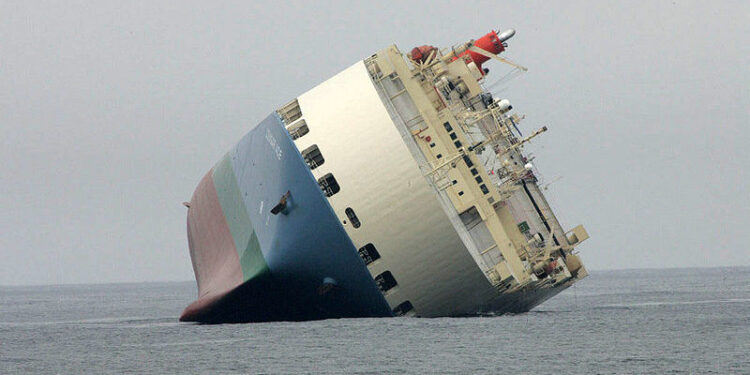
Cougar Ace Crew Rescued by Helicopter
The extreme angle of the vessel made a conventional evacuation extremely difficult. Lifeboats could not be deployed normally, leaving an aerial rescue operation as the safest option.
The U.S. Coast Guard and Alaska Air National Guard launched helicopters to evacuate the 23 crew members from the stricken car carrier.
All 23 crew members were eventually rescued. One crew member suffered a broken leg, but there were no fatalities among the crew during the initial Cougar Ace accident.
The successful rescue marked the end of the immediate life-saving operation. However, the much more complicated task of recovering the severely damaged vessel was only beginning.
A Dangerous Salvage Operation Begins
After the crew had been evacuated, the MV Cougar Ace remained afloat despite its extreme list.
A salvage team from Titan Maritime was brought in to assess the vessel and develop a plan to stabilize and recover it. Working aboard a ship tilted by more than 60 degrees presented extraordinary risks, with decks, machinery spaces and access routes no longer functioning as they would on a normally upright vessel.
The salvage operation suffered a tragic setback when Marty Johnson, a member of the salvage team, died in an accident while working aboard the heavily listing vessel.
His death highlighted the extreme hazards faced by the salvage crews attempting to recover the Cougar Ace.
Towing the MV Cougar Ace Toward Safer Waters
One of the biggest challenges was moving the nearly capsized car carrier away from the open ocean.
Heavy waves and strong winds made it dangerous for salvage workers to remain aboard, while the vessel’s extreme list made conventional ship-handling difficult.
The tug Emma Foss initially helped secure and tow the Cougar Ace. The Sea Victory later took over the towing operation as the salvage team worked to move the vessel toward calmer waters.
The Cougar Ace was eventually brought through Samalga Pass toward the waters near Unalaska. Once the vessel reached Wide Bay, it was secured to a mooring buoy, creating a more stable environment for the next stage of the salvage operation.
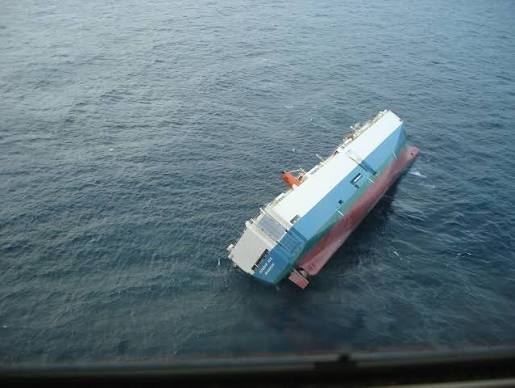
How the Cougar Ace Was Brought Back Upright
Simply pulling on the ship from the outside was not enough to restore the MV Cougar Ace to an upright position.
The salvage team had to carefully control the water and weight distribution inside the vessel. Water was pumped from the vehicle decks while ballast tanks were adjusted to gradually change the ship’s center of gravity.
The process had to be carefully controlled. Removing or adding too much water too quickly could cause the vessel to lose stability and potentially develop a dangerous list in the opposite direction.
The operation therefore became a delicate balance between ballast water management, pumping operations and vessel stability.
From an 80-Degree List to Nearly Upright
The salvage operation gradually reduced the Cougar Ace’s extreme list.
The vessel’s angle was brought down from approximately 80 degrees to around 57 degrees, and eventually to about 12 degrees as the salvage team continued pumping and adjusting the ballast tanks.
The team also had to deal with trapped water inside the hull, oil contamination in machinery areas and the shaft alley, and the condition of the vehicle decks.
Engineers and salvage workers inspected the vessel’s structure and systems while continuing to monitor its stability.
After weeks of work, the ballast adjustments finally brought the vessel close to level. By the evening of August 24, 2006, the Cougar Ace had been reduced to a list of approximately 3 degrees and was effectively back in an upright position.
The achievement marked a major turning point in the Cougar Ace salvage operation.
What Happened to the Cars on the Cougar Ace?
Returning the ship to an upright position was only part of the recovery effort.
The Cougar Ace had been carrying thousands of vehicles while listing at an extreme angle for weeks. The prolonged list exposed the cargo to significant forces and resulted in damage to many of the vehicles.
Once the vessel was stabilized, salvage crews could begin securing the cargo and assessing the condition of the ship and its contents.
The Cougar Ace was subsequently prepared for towing to Portland, Oregon, where the vehicles could be unloaded and the vessel could undergo further inspection and repairs.
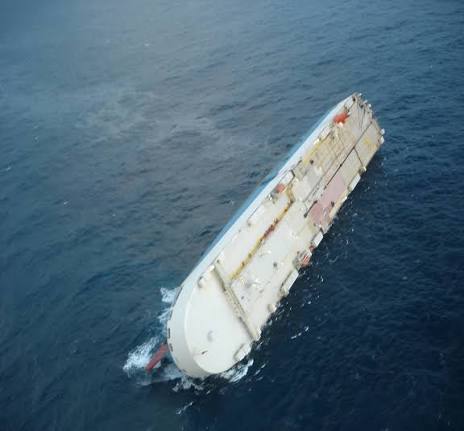
Why the MV Cougar Ace Incident Matters
The MV Cougar Ace incident became an important case study in vessel stability and ballast water management.
The accident was particularly significant because the vessel lost stability during a ballast water exchange, an operation normally associated with maintaining a ship’s stability and meeting environmental requirements.
An investigation by the International Maritime Organization (IMO) examined the sequence of ballast operations and other factors that contributed to the loss of stability. The investigation indicated that the ballast exchange, subsequent pumping intended to correct the list, and fuel consumption from lower tanks all played a role in reducing the vessel’s stability.
The incident also demonstrated that a ship suffering an extreme list does not necessarily sink immediately. Despite being tilted by as much as approximately 80 degrees, the MV Cougar Ace remained afloat for several weeks, allowing salvage crews to move the vessel to safer waters and gradually restore its stability.
Today, the Cougar Ace accident remains a notable example of the challenges involved in Ro-Ro vessel stability, ballast water management and large-scale marine salvage operations.
Source :
https://safety4sea.com
PACIFIC STAR LOGISTICS CO.LTD
📞 +84 938 111 005
📩 info@pasl.com.vn
🏘️27-29 Ngo Thi Bi Street, Tan Hung Ward, Hochiminh City