
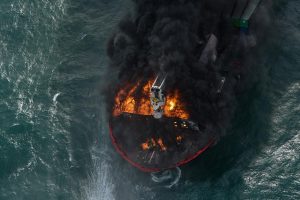
On May 11, 2021, a cargo ship carrying chemicals caught fire off the coast of Sri Lanka, resulting in an environmental disaster that could last for decades for the island. For 15 days, the ship burned near the Sri Lankan coast, thick black smoke visible for miles. Now, the X-Press Pearl has subsided, half-submerged off the coast of Sri Lanka, resting on the shallow sea.
But even though the flames have died down, the problems are just beginning.
The ship contained stacks of containers filled with highly hazardous chemicals. Some have already leaked into the sea, raising concerns about toxicity to marine life. The ship held 46 different chemicals. In addition, large quantities of tiny plastic pellets have been washed ashore on nearby beaches, and hundreds of tons of fuel are sealed inside the sunken vessel, potentially leaking into the sea as well.
Billions of Plastic Pellets
One thing that is clearly visible is the sight of tiny, spherical plastic fragments scattered as far as the eye can see. These plastic pellets… Also known as Nordles, these are used in the production of almost all plastic products. In late May, plastic pellets from the pearl carrier X-Press washed ashore in Negombo, while many fish were washed ashore with swollen bellies and plastic pellets stuck in their gills.
Chemical Pollution
The most lasting impact, likely to affect the country for decades, is chemical pollution. Once these chemicals contaminate the water, they enter the bodies of marine life in the area.
Small fish may die quickly from toxins, but larger fish are less likely to die because they eat smaller fish. The toxins will gradually accumulate in their bodies. In addition, dead fish, turtles, and dolphins have already washed up on the beaches, some with a green color, indicating contamination with metals and chemicals.
This means that fish from that area will be dangerous to humans, not just now, but for many years to come.
Cleanup Efforts
For the fishermen of Negombo, their concern is not just what’s inside the fish, but also the possibility of not being able to catch fish while fishing is banned in the affected areas. This means that many have lost their income and jobs almost overnight.
Activists are calling for an international expert to play a crucial role. The shipping company that owns the X-Press Pearl has hired an international company to handle the crisis.
———————————————————————————————————
PACIFIC STAR LOGISTICS CO.LTD
📞 +84 938 111 005
📩 info@pasl.com.vn
🌐 www.pasl.com.vn
🏘️27-29 Ngo Thi Bi Street, Tan Hung Ward, Hochiminh City